Course
Throughout a Warrior’s 8th grade year they will engage with the following units
-
-
Earth's Place in the Universe
In this unit students learn our place among the stars! We learn about Astronomical units, scale in the solar system, and how gravity works at such a magnificent scale. Students learn how our seasons work, how the moon has a role in controlling the tides and how past civilizations used the stars as a guide to the world. We start the year with wonder on the universal stage!
In this unit students learn our place among the stars! We learn about Astronomical units, scale in the solar system, and how gravity works at such a magnificent scale. Students learn how our seasons work, how the moon has a role in controlling the tides and how past civilizations used the stars as a guide to the world. We start the year with wonder on the universal stage!
-
Genetics, Heredity, Growth and Development
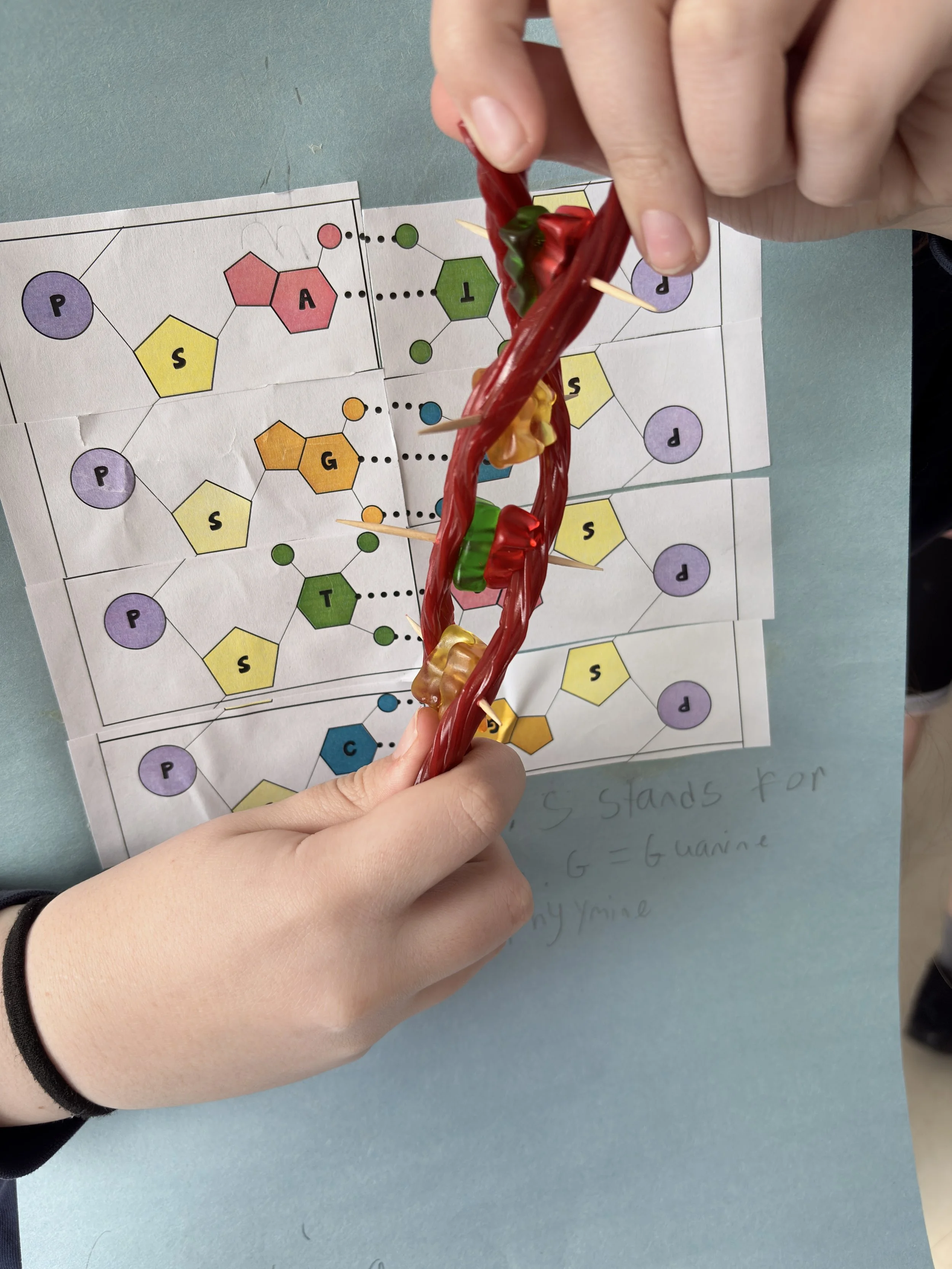
In this unit students will learn how humans and other organisms transfer their DNA through reproduction. Students will learn how dominant and recessive genes work and how to create and read a punnet square. Students also get to learn how animals and plants adapt their structures or habits in order to increase the probability of survival and reproduction.
In this unit students will learn how humans and other organisms transfer their DNA through reproduction. Students will learn how dominant and recessive genes work and how to create and read a punnet square. Students also get to learn how animals and plants adapt their structures or habits in order to increase the probability of survival and reproduction.
-
Is it alive?
Students complete the New York State lab “is it alive?” by understanding what life is in the first place. We review the concepts of what truly makes an organism living, we study cell structure and function, and finish up with observing multiple specimens and determine if they are indeed living or not.
Students complete the New York State lab “is it alive?” by understanding what life is in the first place. We review the concepts of what truly makes an organism living, we study cell structure and function, and finish up with observing multiple specimens and determine if they are indeed living or not.
-
Natural Selection and Evolution
Students will start this unit by understanding how long the earth has been in existence (4.6 billion years!) we will learn different eras and why they are distinct. Students will understand when the first forms of life appeared on the earth and how through natural selection new species emerged, dominated, and for some became extinct. We will look at fossil evidence, anatomical evidence and evidence in various embryos that supports evolution.
Students will start this unit by understanding how long the earth has been in existence (4.6 billion years!) we will learn different eras and why they are distinct. Students will understand when the first forms of life appeared on the earth and how through natural selection new species emerged, dominated, and for some became extinct. We will look at fossil evidence, anatomical evidence and evidence in various embryos that supports evolution.
-
Forces and Interactions
When scientists observe the universe we see natural laws or forces at work. In this unit students will explore how forces work at a distance such as gravity and magnetism and how forces work up close. This unit is paired with our Natural disasters unit in a cross curricular authentic learning experience with the 8th grade team (see What does it take to survive section)
When scientists observe the universe we see natural laws or forces at work. In this unit students will explore how forces work at a distance such as gravity and magnetism and how forces work up close. This unit is paired with our Natural disasters unit in a cross curricular authentic learning experience with the 8th grade team (see What does it take to survive section)
-
What does it take to survive?
Imagine an 8th grader in our rural CNY classroom. They open Alan Gratz’s Refugee and meet Josef, Isabel, and Mahmoud. Suddenly, the world feels much larger than our town's borders. But we aren’t just asking our students to read about these journeys—we are asking them to survive them.
This isn't just a lesson; it’s a multi-sensory immersion into the logistics of displacement, the science of the sea, and the enduring strength of the human spirit.
Imagine an 8th grader in our rural CNY classroom. They open Alan Gratz’s Refugee and meet Josef, Isabel, and Mahmoud. Suddenly, the world feels much larger than our town's borders. But we aren’t just asking our students to read about these journeys—we are asking them to survive them.
This isn't just a lesson; it’s a multi-sensory immersion into the logistics of displacement, the science of the sea, and the enduring strength of the human spirit.
-